The State of Edtech VPATs 2026
When a school district or university reviews an LMS tool, the first accessibility information it sees is often the app directory listing. We read the accessibility field of every active listing in the public Edu App Center catalog, followed every link, and read every Accessibility Conformance Report (ACR) we could reach.
Key findings
- Only 41 of 471 listings (8.7%) lead to an ACR a buyer can open today.
- 320 of 471 listings (68%) say something about accessibility; 151 (32%) say nothing.
- 69 listings (15%) point to an ACR/VPAT of any kind, and 12 of those (17%) now hit a broken link.
- About twice as many listings make a conformance claim with no report (60) as link a working one (41).
- Of the 64 listings that name a WCAG version, 33 (52%) cite WCAG 2.0.
- Of 33 dated ACRs we could read, 8 (24%) are more than two years old; the median age is about 7 months.
- 2 of the 37 ACRs we read are image-only PDFs that a screen reader cannot read.
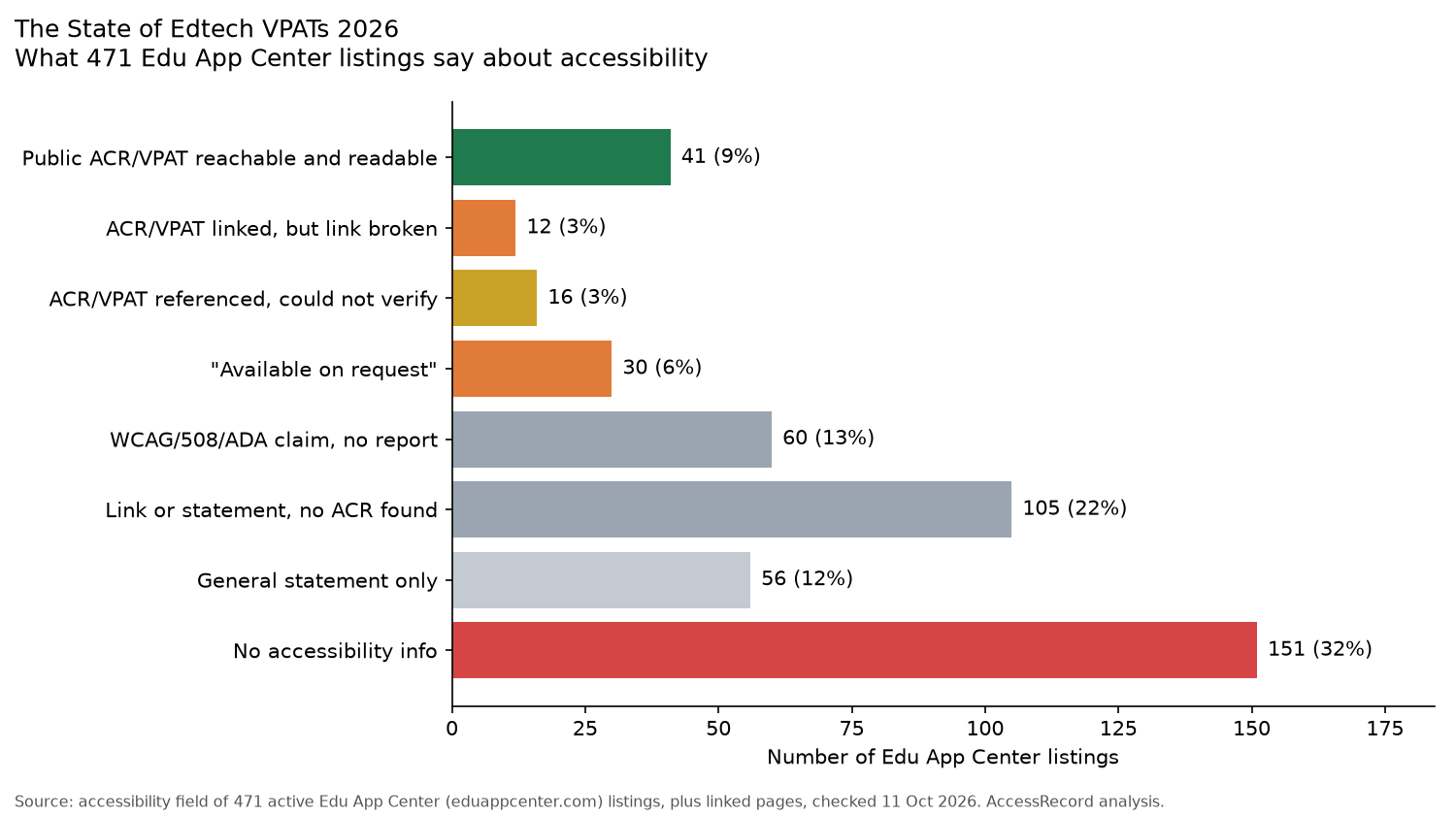
What the listings give a buyer (n = 471)
| Accessibility field | Listings | Share |
|---|---|---|
| A public ACR/VPAT we could open and read (on the listing or one click away) | 41 | 8.7% |
| Links to an ACR/VPAT, but the link is broken (404 or redirects somewhere unrelated) | 12 | 2.5% |
| Mentions an ACR/VPAT we could not verify (login wall, trust portal, blocked bots, private doc) | 16 | 3.4% |
| Documentation "available on request" | 30 | 6.4% |
| Claims WCAG / Section 508 / ADA conformance but links no report | 60 | 12.7% |
| Links a page or document, with no ACR found within one click | 105 | 22.3% |
| General statement only, no standard named | 56 | 11.9% |
| Empty or placeholder ("N/A", "tba", ".") | 151 | 32.1% |
WCAG version named in the listing (n = 64)
- WCAG 2.0: 33 (52%)
- WCAG 2.1: 17 (27%)
- WCAG 2.2: 11 (17%). Ten of these are one vendor's identical statement repeated across its products.
- WCAG 1.0: 3 (5%)
A further 27 listings mention WCAG or W3C without a version.
Link health (n = 165 unique URLs)
- 22 (13%) returned 404 Not Found.
- 15 (9%) did not respond and 13 (8%) refused automated requests (403); we did not count those as broken.
- 23 of the 195 listings that link out have at least one link that returns 404.
Inside the ACRs we could read (n = 37 documents, 31 vendors)
Template version
- VPAT 2.5 / 2.5Rev (or labelled later): 18 (49%)
- VPAT 2.4 / 2.4Rev: 7 (19%)
- VPAT 2.2 or 2.3: 4 (11%)
- Legacy or non-ITI format (pre-2017 Section 508 checklists, VPAT 1.x, WCAG "support statements"): 5 (14%)
- No template version stated: 3 (8%)
ITI's current template is VPAT 2.5Rev (April 2025).
Report date
- 33 of 37 documents state a report date; 4 have none.
- 8 of 33 dated reports (24%) are older than two years. The oldest is from 2016.
- 13 of 33 (39%) are older than one year. The median age is about 7 months.
Highest WCAG version evaluated
- WCAG 2.2: 15 (41%)
- WCAG 2.1: 13 (35%)
- WCAG 2.0: 6 (16%)
- Old Section 508 provisions only: 2
- Unclear (standards table left as template placeholders): 1
Method
- Listing text (n = 471). All active tool listings in the public Edu App Center catalog (eduappcenter.com, the LTI app directory used by Canvas and other LMS admins). We sorted every accessibility field into one category, read each borderline case by hand, and recorded any WCAG version named.
- Linked pages (n = 165 unique URLs, from 195 listings). We fetched every URL in the accessibility fields once on 11 October 2026 and recorded the HTTP status. On pages that loaded, we followed links labelled VPAT, ACR or conformance report, one click deep.
- ACR sample (n = 37 documents from 31 vendors, covering 42 listings). Every ACR or VPAT we could retrieve and read through steps 1 and 2 — not a random sample. For each we recorded the template version, the report date and the highest WCAG version evaluated. A report counts as older than two years if dated before 11 October 2024; a month-only date is set to the 1st.
Caveats
- The listing field is self-reported and often lags the vendor's own website. A listing with no ACR does not mean the vendor has none; it means a buyer starting from the listing will not find one. This measures what a buyer can find, not how accessible the products are.
- Listings are not companies. Some vendors have many listings with identical text; one publisher accounts for 13 of the 30 "on request" listings.
- The ACR sample covers every document we could reach and probably skews toward vendors who maintain their documents, so the real share of stale ACRs is likely higher. With n = 37, treat percentages as indicative.
- Links were checked once, on 11 October 2026; some non-responses may be temporary. Pages behind JavaScript, a login or a request form were counted as "could not verify", not as missing.
- The categories are our classification of free text. The CSV keeps the original excerpt for every listing so anyone can check it.
Download the data
- Listings CSV (471 rows): category, WCAG version named, linked URLs with HTTP status, and ACR details where sampled. Published e-mail addresses are removed.
- ACR sample CSV (37 rows): URL, how it was found, template, report date, age, WCAG version evaluated and format.
- Chart (PNG, 1500 × 840)
Cite this study
Nabin Karna / AccessRecord (2026). The State of Edtech VPATs 2026. Data checked 11 October 2026. https://www.accessrecord.app/research/state-of-edtech-vpats-2026
Embed the chart
Copy this HTML. Please keep the source link.
<a href="https://www.accessrecord.app/research/state-of-edtech-vpats-2026"><img src="https://www.accessrecord.app/research/state-of-edtech-vpats-2026.png" width="1500" height="840" style="max-width:100%;height:auto" alt="Bar chart of 471 Edu App Center listings by what their accessibility field gives a buyer: 41 public ACR reachable and readable; 12 ACR linked but link broken; 16 ACR referenced but could not verify; 30 available on request; 60 WCAG/508/ADA claim with no report; 105 link or statement with no ACR found; 56 general statement only; 151 no accessibility information."></a>
<p>Source: <a href="https://www.accessrecord.app/research/state-of-edtech-vpats-2026">The State of Edtech VPATs 2026, AccessRecord</a></p>
What vendors can do
- Put a link to a current ACR in every marketplace listing. Start with what a VPAT is if you are new to it.
- Replace "available on request" with a public link to the current version.
- Check the links once a quarter; a redesign or a renamed file is the usual cause of a dead link.
- Date and version every report, and re-issue it when the product changes. How to get a VPAT or ACR covers costs and timelines.
- Move to VPAT 2.5Rev and WCAG 2.1 or 2.2, and publish the ACR as tagged PDF or HTML.